What Makes a NABH Certified Workplace Clinic in India Different from a Traditional Office Medical Room?
Walk into most Indian office medical rooms and you will find a cot, a blood pressure monitor, a first-aid box and, if the company is diligent, a visiting doctor for a few hours a week. It satisfies the letter of the Factories Act. It also has almost nothing in common with clinical care.
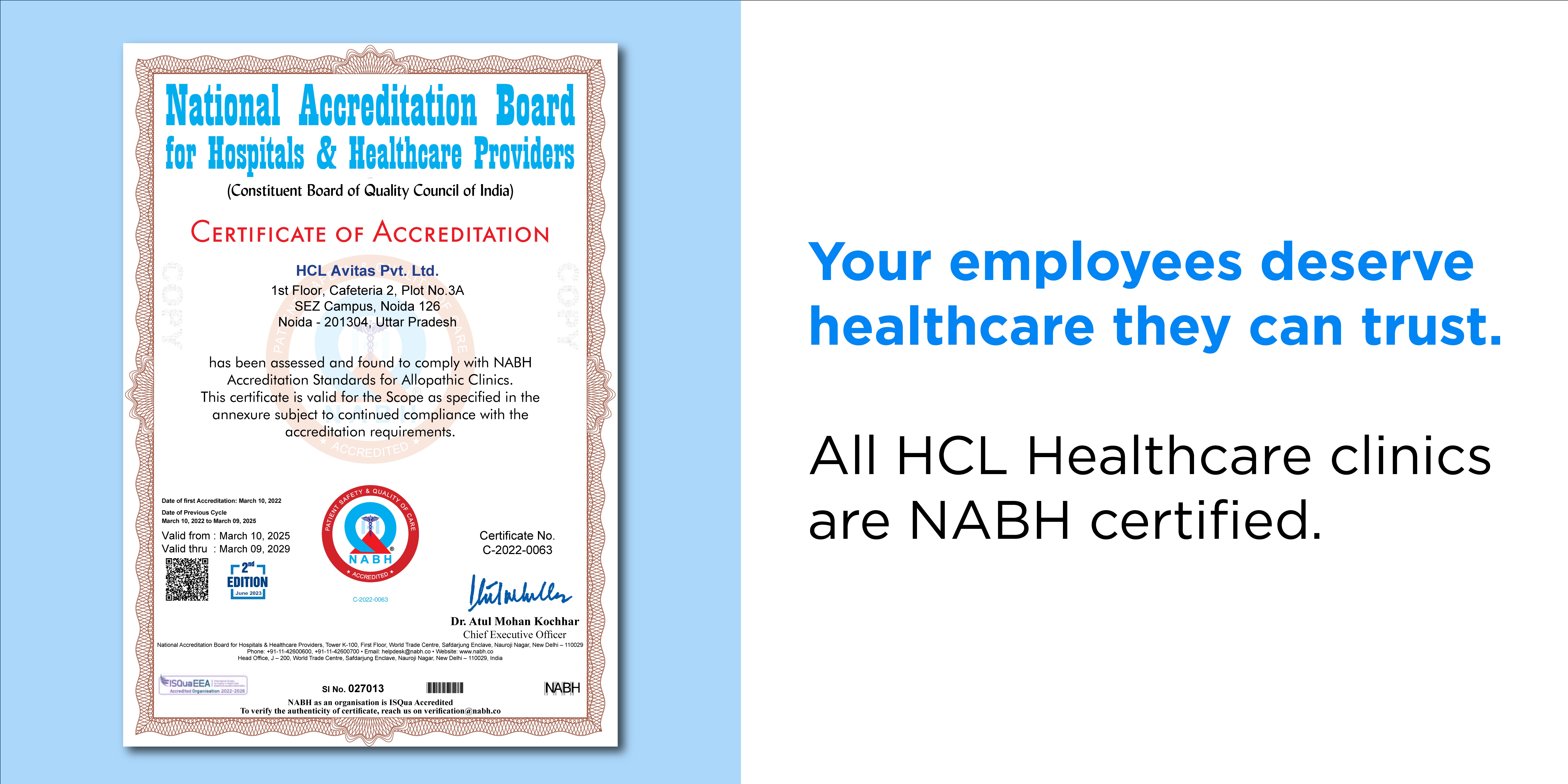
A NABH certified workplace clinic India operates under the same accreditation discipline as the country's leading hospitals. NABH, a constituent board of the Quality Council of India, holds institutional status with the International Society for Quality in Healthcare, which places its standards at par with the world's principal accreditation bodies. The gap between the two models is not cosmetic. It runs through everything from who treats your employees to what happens when something goes wrong.
Scope of services and clinical protocols
A medical room reacts. Someone feels unwell, someone hands them a paracetamol, and the register records the visit. There is no protocol governing when a headache is a headache and when it warrants an ECG.
An accredited clinic works from documented clinical protocols: standard treatment guidelines, defined escalation criteria, medication management with expiry and storage controls, and infection prevention practices that are audited rather than assumed.
The service scope extends beyond episodic complaints into chronic disease follow-up, health screening and vaccination programmes, which is what allows an onsite facility to anchor a clinically led corporate wellness program rather than sit apart from it.
Qualified professionals and emergency response
NABH requires a credential file for every clinical staff member covering qualifications, medical council registration, experience, training certifications and competency assessments, with assessors sampling these files during audit. Contrast that with the typical medical room, where the employer often cannot say with certainty whether the attending nurse's registration is current.
Emergency readiness is the sharpest difference. Accredited facilities maintain defined emergency response procedures, functional resuscitation equipment checked on schedule, staff trained in basic and advanced life support, and rehearsed transfer arrangements with nearby hospitals. In a cardiac event on a factory floor, the difference between a rehearsed protocol and an improvised one is measured in survival.
&nbso;
Medical records and quality assurance
Accreditation standards demand a defined medical record format, completeness audits, confidentiality and access controls, and data management for quality indicators. Records become longitudinal health histories that can flag a rising blood pressure trend across visits. A medical room's register can tell you who visited. It cannot tell you who is getting sicker.
Quality assurance is the habit that separates the two models most durably: incident reporting, periodic internal audits, patient feedback loops and surveillance assessments for accreditation renewal. The clinic is examined by an external assessor against published standards. The medical room is examined by nobody.
Why this matters to employees and employers
Employees calibrate trust quickly. A facility that looks and functions like a clinic gets used; a room with a cot gets avoided until a crisis. Higher trust means earlier presentation, and earlier presentation is where preventive care actually happens.
For employers, an accredited onsite facility is a statement that due diligence teams, prospective hires and auditors can verify independently, and it strengthens compliance posture now that the labour codes have made annual health checkups for employees above 40 a statutory duty. Organisations comparing the two models can review how accredited onsite health centres operate, how they connect to broader wellness offerings and an integrated care model, or speak directly with a corporate healthcare provider that runs NABH-grade facilities at scale.
The bottom line
The cot and the first-aid box were designed for an era when workplace healthcare meant treating cuts and headaches. India's workforce now carries diabetes, hypertension and cardiac risk into the office every day, and the labour codes have turned employee health from a courtesy into a duty.
An accredited clinic meets that reality with protocols, qualified professionals and records that stand up to scrutiny. A medical room merely occupies the space where all of that should be. The question for employers is no longer whether the upgrade is worth it. It is how long the gap can be defended.